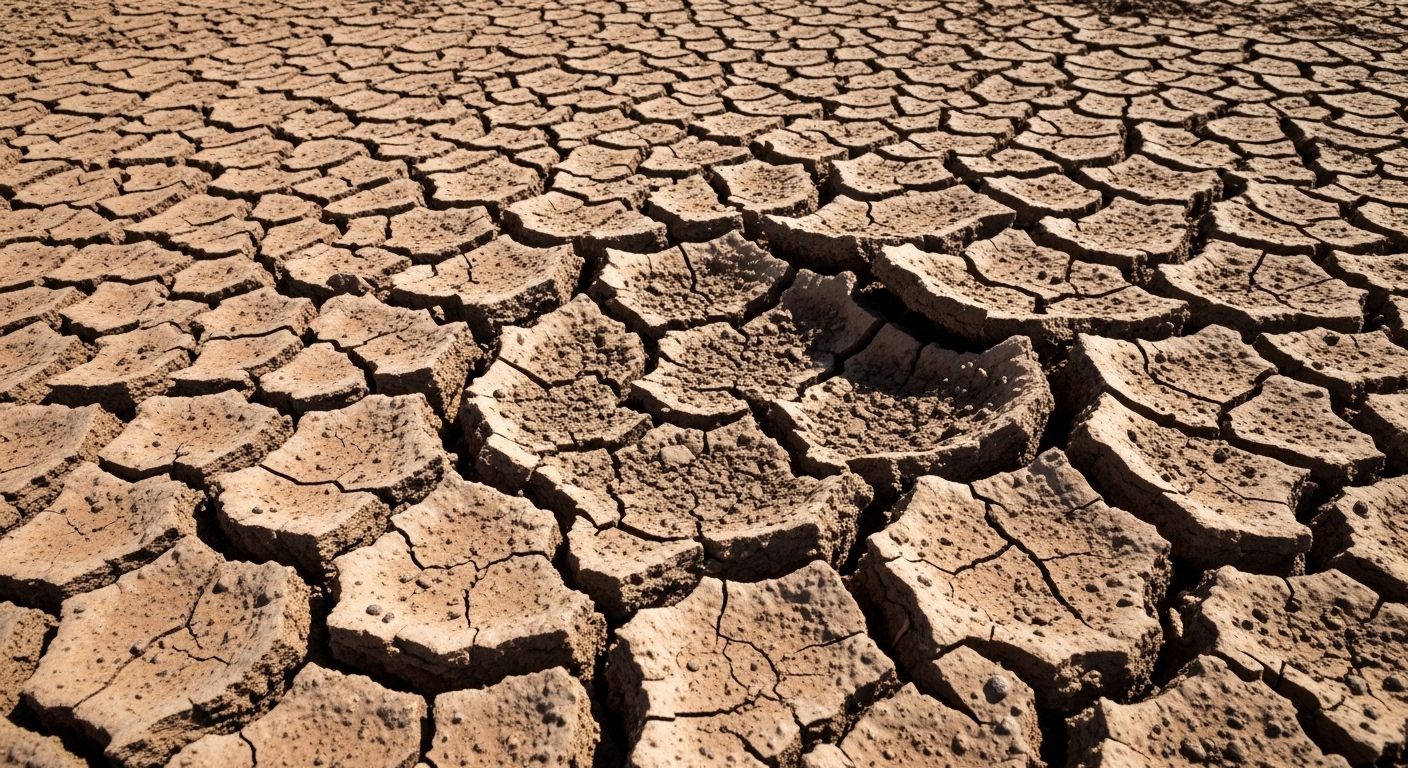
There is no force more fundamental to life than water, and no natural disaster more insidious than its absence. Drought does not announce itself with the drama of a hurricane or the violence of a flood. It creeps in slowly — a winter without snow, a spring without rain, a reservoir that keeps receding toward its mudflats. It tightens its grip month by month, year by year, and by the time its effects are unmistakable, its damage has already been done: crops withered, rivers dry, wells empty, and communities on the move. The American Dust Bowl, the Sahel famines, the Ethiopian drought of the 1980s, and the drying of the western United States all share this signature — a slow catastrophe that unfolds over years and claims its victims through starvation, displacement, and conflict over water.
Climate change is rewriting the mathematics of drought. Warmer air holds more moisture, so it evaporates more water from soils, plants, and reservoirs, and it dries out the land faster. Warmer air also shifts the patterns of rainfall, pushing some regions into permanent deficit while concentrating rain in shorter, more violent bursts in others. The result is that droughts are becoming more frequent, more intense, and more prolonged across much of the world, and the warming atmosphere is squeezing more water out of the land even where total rainfall has not changed. This article explores the science of drought, how climate change is intensifying it, who is most at risk, and the strategies that can help a thirsty world adapt.
What Is Drought?
Drought is not a single thing; it is a cascade of deficits. The cascade begins with meteorological drought — a period of below-normal precipitation. If the deficit persists, it becomes agricultural drought, when soil moisture is too low for crops. Prolonged further, it becomes hydrological drought, when rivers, reservoirs, lakes, and groundwater fall below normal. And eventually, the deficit becomes socioeconomic drought, when the shortage of water affects people — their food, their livelihoods, their health. Each stage feeds the next, and the cascade can take months or years to unfold. This is why droughts are so damaging: they are slow to begin, hard to foresee, and long to end.
The New Role of Evaporation
Climate change is altering the drought cascade in a fundamental way. Traditionally, drought was defined by how much rain fell. But warming introduces a second, increasingly dominant driver: how much water the air takes out. A warmer atmosphere evaporates more moisture from soils and plants — a process called evapotranspiration. This means that even regions that have not seen a decline in rainfall are experiencing soil drying, because the warmer air is pulling more water out of the land. Scientists describe this as "warming-driven drought": the land is drying not because it rains less, but because the air is thirstier. This is a new and particularly insidious form of drought, because it is invisible in precipitation records but devastating on the ground.
Regions Under Pressure
Drought is a global phenomenon, but its effects are distributed by geography, infrastructure, and wealth. The western United States has experienced some of the driest conditions in more than a millennium, with the Colorado River — the water source for forty million people — running at a fraction of its historical flow. The Mediterranean basin, southern Europe, and parts of Central America are drying. The Sahel, southern Africa, and the Horn of Africa, where rain-fed agriculture is the basis of survival, suffer recurrent droughts that tip into famine. South Asia, Central Asia, and parts of China face growing water stress as glaciers retreat and rainfall patterns shift. And Australia, with its inherently variable climate, faces more intense droughts and fires as warming deepens the dry spells.
The Water-Stress Nexus
Drought does not strike a neutral landscape; it strikes regions already under stress from population growth, economic development, and unsustainable water use. Many of the world's most populous regions are already withdrawing water faster than it is replenished, depleting aquifers and draining rivers. Climate change adds the temperature-driven drying on top of this human over-extraction. The result is a nexus of water stress in which climate and consumption reinforce each other: the climate reduces supply, and humanity has already been living beyond it. The regions most at risk — the Middle East, North Africa, South Asia, and parts of the United States and China — are precisely those where the gap between supply and demand is already widest.
The Human Consequences
Drought is a slow disaster with fast consequences when its effects finally land. Food production is the first casualty: crops fail, livestock die, and food prices rise, pushing the poorest into hunger. The Horn of Africa's recurring droughts, amplified by climate change, have repeatedly pushed millions to the edge of famine, and the region's pastoralists have lost livestock by the tens of millions. Water supply is the second casualty: cities ration water, farmers lose access to irrigation, and wells go dry, forcing families to walk further for water or to buy it at prohibitive prices. And the economic and social consequences cascade further: hydroelectric dams run dry, wildfires ignite in parched landscapes, dust storms strip topsoil, and the pressure on water fuels conflict within and between nations.
Displacement and Conflict
Drought is a driver of displacement and instability. When the land can no longer support its people, they move — from countryside to city, and across borders. The Syrian conflict, which exploded into civil war in 2011, was preceded by a devastating drought from 2006 to 2010 that drove more than a million people off the land and into cities, compounding the grievances that fueled the uprising. Similar dynamics are visible in the Sahel, where drought and resource competition contribute to violence and migration. Water is not only a human necessity; it is a geopolitical force, and the regions where drought and water scarcity are worsening are the regions where instability is most likely.
Drought at a Glance
40 million: People who depend on the shrinking Colorado River
~2 billion: People living in countries with high water stress
1200+: Years since the American West was as dry as recent decades
2 billion+: People who experience severe water scarcity at least one month per year
Millions: People pushed into hunger by drought-driven crop failures in the Horn of Africa
The Solutions: Managing a Thirstier World
Adaptation to drought is fundamentally about the management of water — doing more with less, storing what falls, and building resilience into the systems that depend on water.
Efficiency and Conservation
The cheapest water is the water that is not used. In agriculture, which consumes the majority of the world's water, efficiency gains are enormous: drip irrigation can deliver water directly to roots with a fraction of the waste of flood irrigation; better crop choices and soil management reduce the water crops need; and water pricing that reflects scarcity encourages conservation. In cities, fixing leaky pipes, installing efficient fixtures, and managing demand can stretch supplies dramatically. Efficiency is not glamorous, but it is the single most powerful tool for closing the gap between supply and demand.
Storage and Infrastructure
Drought is a problem of timing as much as total amount — too little water when it is needed, too much when it is not. Storage is the answer: reservoirs capture wet-season flows for dry-season use; groundwater recharge banks surplus water in aquifers; and water recycling and desalination, where feasible, add new supplies. The infrastructure of water in a warming world must also be smarter — able to move water between basins, to monitor and manage the system in real time, and to fail gracefully rather than catastrophically.
Governance and Cooperation
The deepest solutions to drought are institutional. Water that crosses borders — as most of the world's major rivers do — requires cooperation rather than conflict, and the institutions that manage shared basins are among the most important adaptation infrastructure on Earth. Within countries, water governance must shift from treating water as an infinite resource to treating it as a shared, finite, and increasingly scarce asset — with allocation rules that protect the most vulnerable and incentivize efficiency. And the social safety nets that protect people when drought hits — drought insurance, food security programs, and emergency water supply — determine whether a drought becomes a hardship or a catastrophe.
Conclusion: Water Is the Canary
Drought is the climate crisis made visible in the most essential of resources. It is not a distant threat; it is happening now, in the reservoirs of the American West, the farmlands of the Horn of Africa, and the basins of the Middle East. The warming atmosphere is making the land thirstier, and the human systems built on the old climate are being asked to operate in a new one. The response is not to despair but to adapt — to use water more wisely, store it more effectively, govern it more cooperatively, and protect the people most exposed. Water is the canary in the coal mine of climate change; the question is whether the world will heed its warning before the mines go dry.
Frequently Asked Questions
What is drought?
Drought is a prolonged deficit of water. It progresses from meteorological drought (low rainfall) to agricultural drought (dry soils), hydrological drought (low rivers, reservoirs, and groundwater), and socioeconomic drought (water shortage affecting people).
How is climate change making drought worse?
Warmer air evaporates more moisture from soils and plants, drying the land even where rainfall has not declined. Warming also shifts rainfall patterns and intensifies the extremes, making droughts more frequent, intense, and prolonged in many regions.
Which regions are most at risk of drought?
The American West, the Mediterranean, the Sahel, southern and Horn of Africa, South Asia, Central Asia, parts of China, and Australia are among the most at risk. Vulnerability is highest where water is already over-extracted and infrastructure is weakest.
What are the main consequences of drought?
Drought causes crop failure and food insecurity, water supply shortages, hydroelectric and economic losses, wildfires, dust storms, and displacement. In the most stressed regions, it contributes to conflict and humanitarian crises.
How can the world adapt to worsening drought?
Through water efficiency and conservation, especially in agriculture; storage in reservoirs, aquifers, and recycled systems; cooperative governance of shared water; and social protection like drought insurance and food security programs.
Related Articles
Glacier Melt and the Global Water Supply — How the retreat of glaciers is shrinking the water that millions depend on.
Extreme Heat: The Deadliest Climate Hazard — Heat and drought often arrive together, compounding the damage.
El Niño, Monsoons, and the Global Food Crisis — How climate cycles drive the rainfall failures behind droughts.