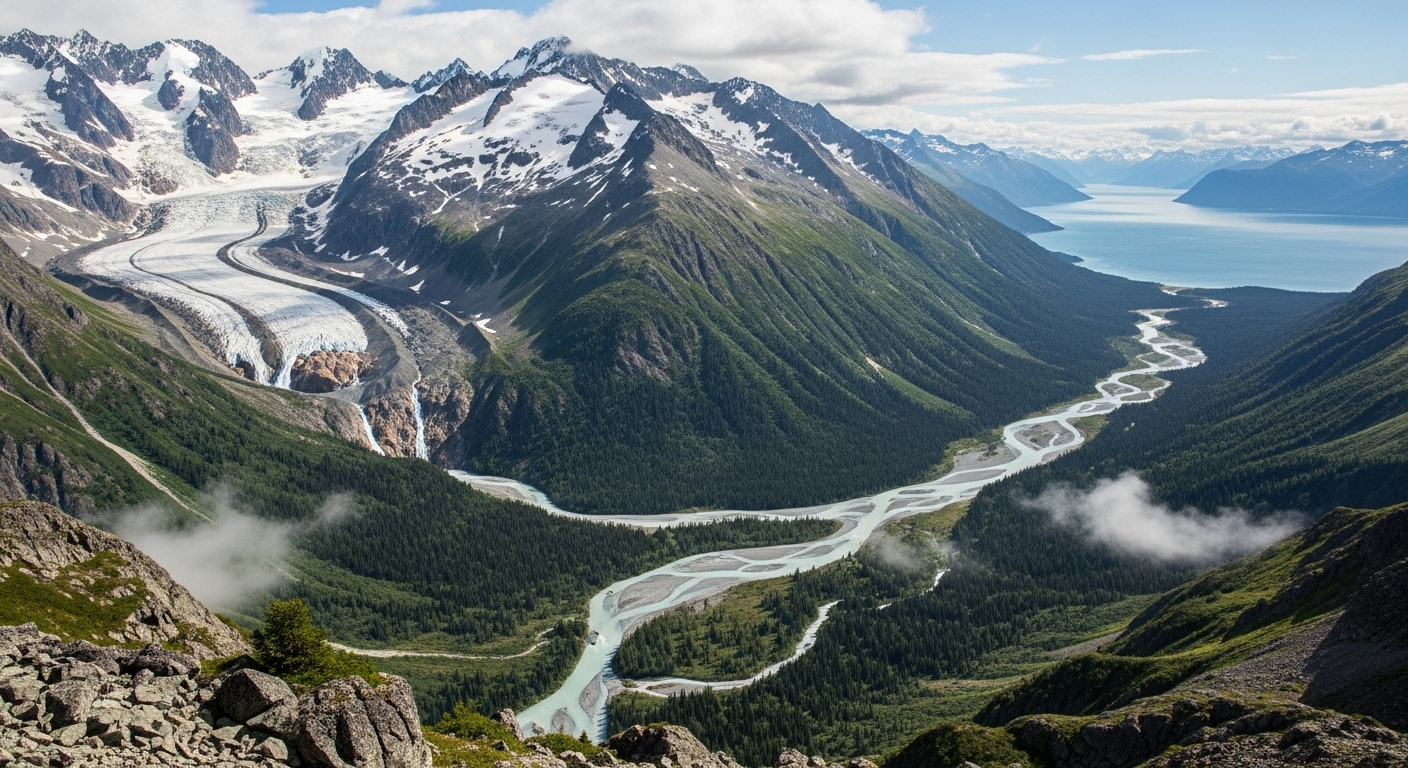
High in the Himalayas, at altitudes where the air is thin and the cold is constant, an extraordinary infrastructure is disappearing. The glaciers that crown Asia's great mountain ranges are the continent's most important storehouses of fresh water. During the dry season, when monsoon rains have long since stopped and the rivers run low, meltwater from these glaciers keeps the Indus, the Ganges, the Brahmaputra, the Yangtze, and a dozen other great rivers flowing. More than a billion people depend on those rivers for drinking water, irrigation, and hydroelectric power. The glaciers are the system's battery — and the battery is draining.
The same story is playing out across the planet. The Andes feed water to cities and farms on the arid Pacific coast of South America. The glaciers of the European Alps supply the Rhine, the Danube, and the Po. The glaciers of Alaska, the Rockies, and the Caucasus feed rivers across North America and Asia. Mountain glaciers, along with the snowpack that accumulates on high peaks, are the world's water towers — and the Intergovernmental Panel on Climate Change (IPCC) has documented that they are melting at a rate without precedent in human history. This article examines how glacier melt threatens water security around the world, which regions are most at risk, and what can be done to prepare for a future with less ice.
The Role of Glaciers in the Water Cycle
Glaciers are rivers of ice that form where snowfall exceeds melting year after year. They accumulate in high mountains, flow slowly downhill under their own weight, and release water through melting and through the calving of icebergs into lakes and seas. What makes them so important for water supply is the timing of that release. Glacier melt is concentrated in the warm summer months, precisely when rainfall is often scarcest and water demand is highest. In effect, glaciers act as natural reservoirs that store winter precipitation and release it during the dry season — smoothing out the seasonal variability of the water cycle.
Water Towers of the World
Mountain regions are often called the "water towers" of the world, and the term is not metaphorical. The Hindu Kush–Himalaya range alone supplies water to ten major river basins that together support more than two billion people. The Andes provide essential dry-season flows to cities like Lima, Quito, and La Paz and to the irrigation systems of coastal Peru and Chile. The European Alps contribute a significant share of the dry-season flow of major continental rivers. Central Asia's glaciers feed the Amu Darya and Syr Darya, which sustain cotton farming and millions of people in one of the world's most water-stressed regions. In nearly every case, the same pattern holds: glaciers store water in the wet season, release it in the dry season, and buffer the variability that makes agriculture and urban water supply viable.
The significance of glaciers extends beyond volume to timing and quality. Glacier meltwater flows steadily even in drought years, when rainfall is scarce, providing a degree of reliability that is priceless to farmers and water managers. The cold, sediment-rich water from glaciers also influences downstream ecosystems and the health of estuaries and deltas. And because glacial systems integrate climate conditions over many decades, they are sensitive indicators of long-term change — the frozen records of the planet's warming.
How Climate Change Is Melting the Ice
Glaciers respond to a simple balance: how much snow falls, and how much melts. Climate change is disrupting both sides of that balance. Rising temperatures increase the rate of melting and extend the melt season. Warmer air also means that at any given altitude, precipitation falls as rain rather than snow, reducing the accumulation that feeds the glacier's upper reaches. The result is that glaciers are losing mass across virtually the entire globe.
The Global Retreat
The observational record is stark. Glaciers monitored by the World Glacier Monitoring Service have lost mass every year for decades. Satellite surveys show that the world's glaciers have collectively lost more than 250 billion tonnes of ice per year on average over the past two decades — an amount comparable to the total mass of the Antarctic ice sheet's contribution and a major component of global sea level rise. Mountain glacier loss is accelerating, not slowing. In the Alps, glaciers have lost roughly 60 percent of their volume since 1850 and the rate of loss has accelerated dramatically in recent decades. In the Himalayas, nearly all glaciers are retreating, and the region's ice mass loss has more than doubled since the turn of the millennium. The projections are dire: under current emissions, most of the world's smaller glaciers — particularly those below 3,500 metres — could lose the majority of their volume by the end of the century.
The Peak Water Paradox
Perhaps the most dangerous aspect of glacier retreat is a phenomenon known as "peak water." As glaciers initially melt faster, they release more meltwater than they historically would — a temporary surge in runoff. Many downstream communities experience this as abundant water, even as the ice that sustains it is vanishing. But the surge is a one-time event. Once a glacier has lost enough mass, its annual meltwater begins to decline, even as the rate of melting per unit of ice continues to rise. Beyond the peak, runoff falls steadily, and the basin must get by on rainfall alone. Some Asian basins, where glaciers are small and vulnerable, may already be past their peak. Others will cross it within decades. The timing matters enormously for planning: infrastructure built during the era of abundant meltwater may be stranded when the water disappears.
Regions at Risk
The consequences of glacier loss are unevenly distributed, and the regions most at risk are those where people are already living close to the edge of water stress.
The Hindu Kush–Himalaya
This is the most consequential glacier region on Earth. More than two billion people depend on rivers fed by its ice and snow, and the basin's water supports the food production of some of the most populous nations in the world. The Indus basin is the most vulnerable: it relies on glacier and snow melt for a large share of its flow, and it irrigates the breadbaskets of Pakistan and northwest India. The Ganges and Brahmaputra basins, which support hundreds of millions across India and Bangladesh, also depend substantially on high-mountain meltwater, particularly in the pre-monsoon dry season. Climate models project that these basins will face increased water stress as the glaciers retreat, even before accounting for rising demand from population growth and economic development. The stakes could hardly be higher: water disputes, food security, and the livelihoods of more than a billion people all hinge on the fate of the high-mountain ice.
The Andes
The tropical Andes have lost a significant fraction of their glacier area in recent decades, and the region is on the front line of glacier-related water risk. Cities like Lima, Peru — one of the world's driest capitals, built in a coastal desert — depend on mountain runoff for a large share of their water. In the high Andean valleys of Peru and Bolivia, communities have traditionally depended on glacier-fed streams and high-altitude wetlands called bofedales. As the ice disappears, the flow declines and the seasonality shifts, threatening both urban supplies and the high-mountain agriculture and grazing that sustains indigenous communities. The situation is compounded by rising demand: growing cities, mining, and agriculture are all competing for a shrinking resource.
Central Asia and the European Alps
Central Asia's glaciers feed rivers that are the lifeblood of countries like Kyrgyzstan, Tajikistan, Uzbekistan, and Kazakhstan, where they support cotton, wheat, and the region's hydroelectric systems. Competition for water in the region is already intense, and glacial retreat is projected to worsen shortages. In Europe, the Alps supply dry-season water to some of the continent's most important rivers, and the accelerating loss of Alpine glaciers is raising concerns for summer river flows, hydropower, and navigation. While Europe has the financial resources to adapt, the disappearing glaciers are a clear signal of the speed of change.
Glacier Water at a Glance
2+ billion: People who depend on water from the Hindu Kush–Himalaya rivers
60%: Share of Alpine glacier volume lost since 1850
250 billion tonnes: Average annual ice loss from the world's glaciers in recent years
10: Major Asian river basins fed by Himalayan ice and snow
1 in 4: People globally who live in or depend on mountain-fed water systems
Glacial Lake Outburst Floods
Glacier retreat is not only a slow story of diminishing flows — it also carries a fast, catastrophic risk. As glaciers melt, they leave behind moraine-dammed lakes, and the unstable debris walls that hold those lakes can fail catastrophically. A glacial lake outburst flood, or GLOF, can release millions of cubic metres of water in hours, sending a wall of water and debris down the valley below. GLOFs have caused devastating losses in the Himalayas, the Andes, and Central Asia, destroying villages, roads, bridges, and hydroelectric infrastructure. As warming accelerates the formation and expansion of glacial lakes, the risk of GLOFs is rising. Nepal and Bhutan, among the most exposed countries, have invested in early warning systems and engineering projects to drain or stabilize the most dangerous lakes, but thousands of lakes across the mountains remain unmonitored.
Adaptation: Preparing for Less Ice
Because the glaciers cannot be saved by local action alone, the global response is to cut emissions and the regional response is to adapt. Both are essential.
Reducing Emissions
The only way to stop the glaciers from disappearing is to stop the warming that is melting them. The IPCC's projections are unambiguous: the amount of future glacier loss depends almost entirely on the trajectory of global emissions. Under a strong mitigation scenario consistent with limiting warming to 1.5°C, many glaciers could retain a significant fraction of their mass; under high-emissions scenarios, the loss of most small and medium glaciers by 2100 is effectively locked in. Every fraction of a degree of avoided warming preserves ice, water, and the communities that depend on them.
Water Management and Resilience
While emissions policy is set at the global level, water resilience is built at the basin level. Investments in water storage — reservoirs, groundwater recharge, and efficient irrigation — can substitute for the natural storage that glaciers provide. Improvements in water-use efficiency across agriculture, industry, and cities can stretch limited supplies much further. Integrated water resource management that plans for a future with less ice and more variability, rather than relying on historical runoff data, is critical. And transboundary cooperation, in basins where rivers cross borders, is essential to prevent scarcity from escalating into conflict. The days of abundant, predictable glacier meltwater are ending; the era of careful, adaptive water management is beginning.
Conclusion: The Water We Depend On
The glaciers are more than scenery; they are the world's frozen reservoirs, storing water for the seasons and the regions that need it most. Their retreat is one of the clearest and most consequential signals of climate change, and its effects are already visible in the rivers that supply billions of people. The challenge is twofold: to cut the emissions that are melting the ice, and to build the water systems that can survive a world with less of it. Neither task is easy, but both are possible, and both are urgent. Every glacier saved by climate action is water secured for the future; every year of delay is water lost. The mountains are telling us the truth about the climate — it is time to listen.
Frequently Asked Questions
Why are glaciers important for water supply?
Glaciers act as natural reservoirs that store winter precipitation and release it during the warm, dry summer months when rainfall is scarce and demand is high. They provide a steady, reliable flow that supports agriculture, drinking water, and hydropower for billions of people.
How fast are the world's glaciers melting?
The world's glaciers are losing more than 250 billion tonnes of ice per year on average, and the rate is accelerating. Most monitored glaciers have lost mass every year for the past two decades, with the fastest losses in the Alps, the Andes, and the Hindu Kush–Himalaya.
What is peak water?
Peak water is the point at which a glacier's meltwater runoff reaches a maximum and then begins to decline. As glaciers first warm, they release more meltwater, but once enough mass is lost, the annual runoff falls — leaving downstream communities with less water even as melting continues.
Which regions are most at risk from glacier melt?
The Hindu Kush–Himalaya region, the Andes, and Central Asia are among the most at risk. Their dense populations, heavy dependence on rain-fed and melt-fed agriculture, and limited alternative water sources make them especially vulnerable to glacial retreat and the floods that accompany it.
Can we stop glacier melt?
We cannot stop glaciers that are already committed to melting, but we can limit how much more is lost by cutting greenhouse gas emissions. Under strong mitigation, many glaciers can survive; under high emissions, most small and medium glaciers are projected to largely disappear by 2100.
Related Articles
Glacier Retreat: The Hard Evidence of Warming — The observations documenting the accelerating loss of the world's ice.
Rising Sea Levels: The Global Coastal Crisis — The other face of melting ice, as glacier and ice sheet losses raise the world's oceans.
Permafrost Thaw: The Arctic's Dangerous Feedback — How the frozen ground of the high latitudes is thawing and releasing carbon.