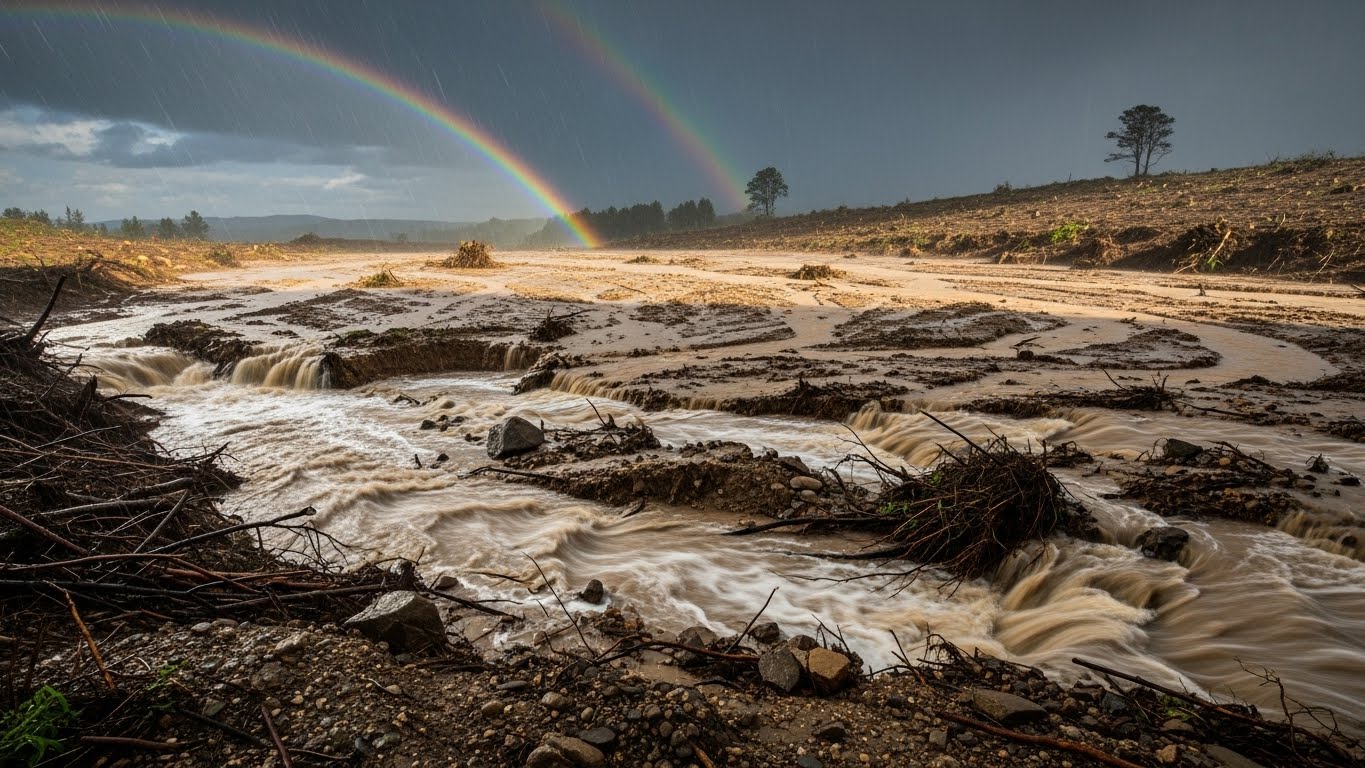
In July 2021, a storm stalled over the valleys of western Germany and Belgium, and the rain did not stop. In a single day, more rain fell than the region normally receives in two months — water that had no place to go. Rivers rose within hours, flash floods swept through villages, and more than two hundred people died, most of them in their homes or on the roads. The flood was not merely a natural disaster; attribution studies found that climate change had made the rainfall event substantially more likely and more intense. The following year, Pakistan received monsoon rains so extreme that a third of the country was submerged, displacing more than thirty million people and causing more than $30 billion in damage. The same pattern repeated in cities from Seoul to New York, where record-breaking downpours overwhelmed drainage systems designed for a cooler world.
Floods are the most common natural disaster on Earth, and they are becoming more destructive. The physics is simple and relentless: a warmer atmosphere holds more water vapour — about seven percent more for every degree Celsius of warming — and that extra water shows up in the atmosphere's most dramatic events. Heavier downpours, more intense storms, and the deluges that turn streets into rivers are all the signature of a warming world. This article explores the science of flood generation, how climate change is intensifying it, who is most exposed, and how to protect communities from the water that comes too fast.
Why Floods Happen
A flood occurs when water arrives faster than the land and its infrastructure can absorb or channel it away. The sources of flooding are various. Flash floods are caused by intense, short-duration rainfall that overwhelms streams, valleys, and urban drainage within hours. River floods occur when prolonged rainfall or snowmelt fills rivers beyond their banks, inundating floodplains for days or weeks. Coastal floods are driven by storm surge and high tides pushing ocean water inland, increasingly amplified by sea level rise. And urban floods are a special case, where impermeable surfaces — roads, roofs, and parking lots — prevent water from soaking into the ground and force it to flow, often exceeding the capacity of the drainage systems built for a different era. Each type has its own dynamics, but all are amplified by the same warming that loads the atmosphere with water.
The Climate Amplifier
Climate change amplifies floods through several mechanisms. The most direct is the increase in the atmosphere's moisture-holding capacity: the same storm system now carries and releases more water than it would have in a pre-warming world. The second is the intensification of rainfall: a larger share of the rain that falls arrives in shorter, more violent bursts, because the warmer atmosphere energizes convection. The third is the shift of precipitation patterns: some regions are receiving more total rainfall, and the wettest days are getting wetter almost everywhere. And the fourth is the compounding effect of sea level rise, which raises the base on which storm surge and high tides build. Attribution studies have documented each of these effects in specific flood events, showing that climate change made rainfall and flood magnitudes greater than they would otherwise have been.
The Changing Rainfall Record
The observational record confirms what the physics predicts. Across much of the world, the intensity of extreme rainfall is increasing — the heaviest downpours are heavier, and they arrive more often. Studies of rainfall data from Europe, Asia, the Americas, and Australia have found a consistent pattern: the wettest days of the year are getting wetter, and the threshold for "extreme" rainfall is being exceeded more frequently. The 1-in-100-year flood, the design standard for much of the world's infrastructure, is becoming more frequent — in many places, a flood that was expected once a century now arrives every few decades or less. This is a design problem of enormous consequence: infrastructure built to the climate of the past is increasingly inadequate for the climate of the present.
The Compound Events
The most dangerous floods are often compound events — combinations of hazards that interact. A storm surge arriving at high tide; extreme rainfall falling on already saturated ground; a typhoon that brings both wind-driven surge and record rainfall; the sequential floods of a wet season that never releases its grip. Climate change is increasing the frequency of compound events, and attribution research is beginning to quantify the ways in which warming makes them worse. The 2017 flooding of Houston from Hurricane Harvey combined record rainfall, a stalled storm, and extensive paved surfaces; the 2022 Pakistan floods combined monsoon extremes with glacier-melt-influenced river flows and prior saturation. The lesson of compound events is that flood risk cannot be assessed hazard by hazard; it must be understood as the interaction of hazards, exposure, and vulnerability.
Who Is Most Exposed
The burden of flooding is deeply unequal, both across countries and within them. Globally, the populations most exposed to floods are concentrated in South and East Asia — the deltas and floodplains of Bangladesh, India, China, and Vietnam, where dense populations live on land that rivers claim. The poorest countries face the greatest flood risk with the least capacity to respond: their drainage is minimal, their housing is fragile, and their insurance is absent. Within rich countries, the exposure is also unequal — the lowest-income neighbourhoods are often located in flood-prone zones, and the poorest households are the least able to evacuate, recover, or rebuild. The social cost of flooding is paid most heavily by those with the fewest resources, and the gap is widening as floods intensify.
The Urban Flood Problem
Cities are on the front line of flood risk, and the risk is growing faster than adaptation. The urban fabric — concrete, asphalt, and compacted soil — prevents water from infiltrating the ground, so rainfall that once soaked into soil now runs off, overwhelming drains and flowing into streets and basements. Rapid urbanization in the developing world is building exposure faster than infrastructure can keep up, and the stormwater systems of most cities were designed for rainfall intensities that are already being exceeded. The floods of New York, Seoul, London, Mumbai, and dozens of other cities have demonstrated that no city is immune, and that the urban drainage systems of the past are no match for the rainfall of the future.
Floods at a Glance
7%: More water vapour in the atmosphere per degree Celsius of warming
220: Lives lost in the 2021 Germany–Belgium flash floods
1/3: Share of Pakistan submerged in the 2022 floods, displacing 30+ million people
1-in-100: The flood standard becoming more frequent as rainfall intensifies
Most common: Floods are the world's most frequent natural disaster
Protecting People from the Water
Flood protection is among the best-developed and most effective forms of climate adaptation, and the tools are proven. The challenge is deploying them at the pace and scale required.
Hard Infrastructure
Traditional flood defenses — levees, dams, storm surge barriers, and pumping systems — have protected cities and farmland for centuries, and they remain essential. But hard infrastructure has limits and can create a false sense of security: a levee protects the land behind it while concentrating flood risk elsewhere, and over-reliance on defenses can encourage development in places that should not be built. Modern flood management increasingly combines hard infrastructure with a recognition that some flooding is inevitable and must be accommodated.
Room for the River
The emerging paradigm is "working with water" rather than fighting it. The Dutch "Room for the River" program lowered floodplains and widened channels to give rivers space to flood safely, rather than confining them. In cities, the approach is "sponge city" design — permeable surfaces, parks that double as detention basins, green roofs, and restored wetlands that absorb rainfall rather than channeling it into overwhelmed drains. Nature-based solutions like mangroves and wetlands buffer coasts from surge and absorb river floods. These approaches are often cheaper than hard defenses, provide co-benefits for wildlife and recreation, and are more resilient to the rising intensity of rainfall.
Warning, Preparedness, and Insurance
Beyond infrastructure, the human systems matter. Early warning systems that forecast heavy rainfall and rising rivers give people time to evacuate, and the 2021 European floods showed the deadly cost of inadequate warning. Flood mapping and zoning keep development out of the most dangerous areas. Building codes that require elevated or flood-resistant construction reduce damage. And insurance and disaster funds allow communities to recover and rebuild — though the rising cost of floods is testing the limits of the insurance model, just as it is for hurricanes and wildfire.
Conclusion: Learning to Live with Water
Floods are the most universal of disasters, and climate change is making them more frequent and more destructive. The water is coming faster, and the systems built for a cooler world cannot hold it. The response is not simply to build higher walls, though walls have their place; it is to rethink the relationship between land and water — to give rivers room, to make cities absorbent, to keep people out of harm's way, and to warn and prepare before the water arrives. And beneath the engineering lies the same root cause: the warming atmosphere that holds more water is the product of the greenhouse gases in the sky. Every reduction in emissions reduces the rainfall of the future. Until then, the world must build, plan, and prepare for the water that comes too fast.
Frequently Asked Questions
How does climate change cause more flooding?
A warmer atmosphere holds about seven percent more moisture per degree of warming, so storms release heavier rainfall. Climate change also intensifies rainfall, shifts precipitation patterns, and amplifies coastal flooding through sea level rise.
What are the different types of floods?
Flash floods from intense short rainfall, river floods from prolonged rain or snowmelt, coastal floods from storm surge and high tides, and urban floods where impermeable surfaces overwhelm drainage. Climate change amplifies all of them.
Why is the 1-in-100-year flood becoming more common?
Because extreme rainfall is intensifying, the rainfall thresholds that defined a 1-in-100-year flood are being exceeded more often. In many regions, floods previously expected once a century now arrive more frequently, making infrastructure built to old standards increasingly inadequate.
How can communities protect against floods?
Through hard defenses like levees and barriers; "room for the river" and sponge city design; nature-based solutions like wetlands and mangroves; early warning and evacuation systems; flood mapping and zoning; and insurance and disaster funds for recovery.
Are floods getting worse everywhere?
Extreme rainfall is intensifying across most of the world, but flood impacts depend on exposure and vulnerability. The populations most exposed are concentrated in South and East Asia and in low-income neighbourhoods, which face the greatest risk with the least capacity to respond.
Related Articles
Extreme Weather: How Climate Change Is Supercharging Storms, Floods, and Wildfires — The broader pattern of weather extremes, of which floods are the most common.
Hurricanes and Tropical Storms: The Warming Connection — The storms that bring record rainfall and storm surge to coasts.
Climate Adaptation: Living with the Change We Cannot Avoid — The adaptation systems that protect communities from rising flood risk.