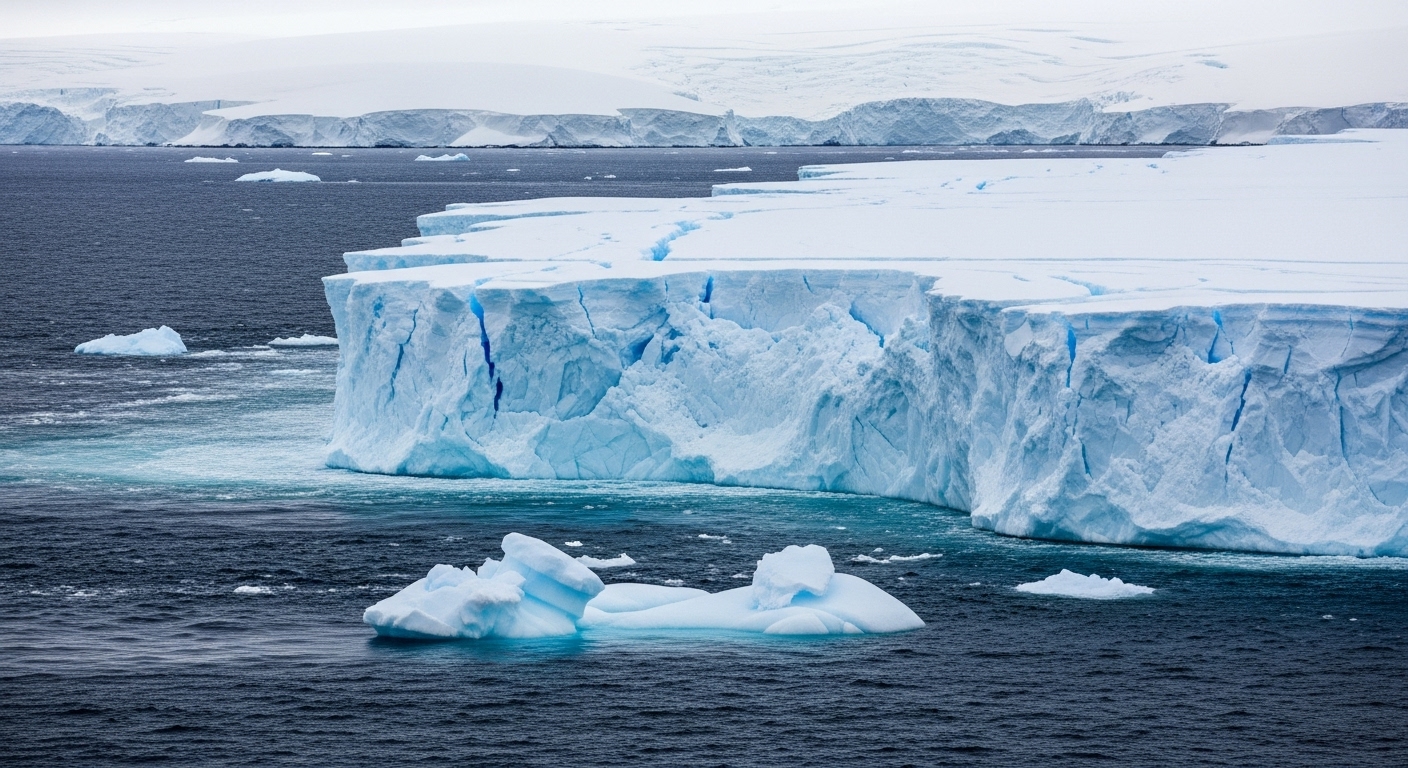
At the bottom of the world, a continent of ice holds the fate of the world's coastlines in its frozen grasp. Antarctica is the coldest, driest, and windiest place on Earth, and it is covered by an ice sheet that contains more than sixty percent of the planet's fresh water — enough ice, if it all melted, to raise global sea level by nearly sixty metres. For most of human history, Antarctica has been a sleeping giant, its vast ice sheet locked in a frozen equilibrium. But the giant is waking. The western flank of the continent, where the ice is grounded below sea level, is losing ice at an accelerating rate, and the warming atmosphere and ocean are reaching into the continent in ways that scientists did not fully anticipate.
The fate of Antarctica is the largest single unknown in the projection of future sea level rise, and the stakes could not be higher. A sea level rise of a few metres would reshape the world's coastlines, inundating the deltas where hundreds of millions of people live and forcing the relocation of many of the world's great cities. The scientific community has watched with growing concern as the Antarctic ice sheet has begun to respond to warming faster than the models predicted. This article explores the structure of the Antarctic ice sheet, the processes destabilizing it, the risk of collapse, and what the southern continent means for the future of the planet.
The Anatomy of the Ice Sheet
The Antarctic ice sheet is not a single uniform mass; it is divided into three major components with very different characters. The East Antarctic Ice Sheet is by far the largest, holding enough ice to raise sea level by more than fifty metres, and it sits mostly on bedrock above sea level — a configuration that makes it relatively stable. The West Antarctic Ice Sheet is much smaller — enough ice for about five metres of sea level — but its configuration is far more vulnerable: much of its ice is grounded on bedrock that lies below sea level, sloping downward toward the interior. And the Antarctic Peninsula, the finger of land that reaches toward South America, is the fastest-warming part of the continent, its ice shelves collapsing in dramatic events over the past two decades.
Ice Shelves: The Brakes of the Ice Sheet
The key to the stability of the grounded ice lies in the ice shelves — the floating tongues of ice that extend from the glaciers into the ocean. Ice shelves act as brakes: they buttress the grounded ice behind them, slowing its flow toward the sea. When an ice shelf thins or collapses, the braking is released, and the glaciers behind it accelerate, discharging their ice into the ocean. The Larsen A and Larsen B ice shelves on the Antarctic Peninsula collapsed in 1995 and 2002, and the glaciers that fed them accelerated dramatically in response. The Thwaites Glacier — dubbed the "Doomsday Glacier" — and the Pine Island Glacier, which drain much of West Antarctica, are losing ice precisely because the ice shelves that restrain them are thinning and retreating under the influence of warm ocean water.
The Mechanisms of Collapse
The destabilization of the West Antarctic ice sheet is driven by processes that are now well understood, and all of them are alarming.
Ocean-Driven Melt from Below
The most important mechanism is the melt of ice shelves from below by warm ocean water. Circumpolar Deep Water, which is warming as the global ocean warms, flows onto the Antarctic continental shelf and reaches the undersides of the ice shelves, melting them from beneath. The melting thins the shelves, reduces their buttressing, and allows the glaciers to accelerate. As the grounding line — the point where the ice leaves the bedrock and begins to float — retreats, it moves into deeper bedrock that slopes downward toward the interior. Because the ice is thicker in the deeper interior, the retreat can become self-sustaining: the deeper the water, the more ice exposed to melt, the faster the retreat, in a process called marine ice sheet instability. Once this process begins, it can be difficult or impossible to stop.
Hydrofracturing and Cliff Collapse
Two further mechanisms accelerate the loss. Hydrofracturing occurs when meltwater on the surface of an ice shelf or glacier fills crevasses and widens them by freezing, weakening the ice until it breaks. This is the process that doomed Larsen B, whose surface was covered in ponds of meltwater during the unusually warm summer before its collapse. And once an ice shelf is gone, the exposed ice cliffs at the glacier's front can become unstable and collapse under their own weight — marine ice cliff instability. The combination of these mechanisms means that the loss of West Antarctica's ice is not a slow, linear process but one that can accelerate abruptly as thresholds are crossed.
The Observed Change
The observations confirm that the loss is underway. Antarctic ice loss has accelerated over the past two decades, driven overwhelmingly by West Antarctica and the Peninsula. The continent is losing ice at a rate that now contributes a significant and growing share of global sea level rise. The Thwaites and Pine Island glaciers are thinning and retreating, their grounding lines moving inland. The ice shelves that restrain them are losing mass, and some show the crevassing and thinning that precede collapse. The warming is also reaching East Antarctica: heatwaves have struck the continent, including an extraordinary event in 2022 when temperatures soared more than 30°C above normal at the Concordia station. The sleeping giant is stirring across its entire mass.
The Commitment of Sea Level
The most important fact about Antarctic ice loss is the commitment it represents. The ice sheet responds slowly, but once destabilized, its loss is difficult to reverse on human timescales. The melt of the past decades has committed sea level to continue rising for centuries, even if emissions were cut immediately. The question is how much more becomes committed in the coming decades. Under current emissions, the Antarctic contribution to sea level could reach a metre or more by 2100, and several metres over the following centuries. The decisions made now determine whether the ice sheet's collapse remains a contained process or becomes the defining feature of the future of the world's coastlines.
Antarctica at a Glance
60 metres: The sea level rise locked in Antarctica's ice
5 metres: The contribution of the vulnerable West Antarctic Ice Sheet
2002: The collapse of the Larsen B ice shelf, releasing the glaciers behind it
Doomsday: The nickname of Thwaites Glacier, a keystone of West Antarctic stability
30°C: The extraordinary 2022 East Antarctic heatwave anomaly
The Consequences of Collapse
If the West Antarctic ice sheet were to collapse, the consequences would unfold over centuries but would ultimately transform the world. Global sea level would rise by several metres, inundating the deltas and coastal cities that house a large share of humanity. Bangladesh, the Mekong and Nile deltas, the low-lying coastlines of Florida, the Gulf states, and the Pacific islands would all face existential inundation. The economic and social costs would be measured in trillions and would be borne disproportionately by the world's poorest. And the loss would not stop at West Antarctica: the destabilization of the ice sheet could, over very long timescales, threaten the far larger East Antarctic Ice Sheet, whose collapse would commit the world to tens of metres of sea level rise. The Antarctic ice sheet is the single largest variable in the future of the world's coastlines.
What Can Be Done
The response to the Antarctic threat is, fundamentally, the same as the response to climate change itself, but the stakes sharpen the urgency. The processes destabilizing the ice sheet — the warming ocean and atmosphere — are driven by greenhouse gas emissions, and the only way to stop the destabilization is to stop the warming. Every degree of avoided warming reduces the melt that reaches the ice, and every year of action reduces the commitment of future sea level rise. The models are clear that the amount of Antarctic ice loss by 2100 and beyond depends directly on the emissions pathway: under strong mitigation, the loss is limited and the collapse of the vulnerable sectors may be avoided; under high emissions, the loss accelerates and the commitment becomes catastrophic.
Preparing for the Rise
Alongside mitigation, the world must prepare for the sea level rise that is already committed. Coastal adaptation — protecting, elevating, and where necessary retreating — is a multi-decade project that must begin now, because the decisions made in the coming years will determine the shape of coastlines for centuries. The recognition of the Antarctic risk argues for the most precautionary approach to the climate: the ice sheet is a system in which the worst outcomes cannot be ruled out, and prudent policy treats the risk seriously. The sleeping giant is waking, and the world should not wait for it to stand up before acting.
Conclusion: The Continent That Decides the Coastline
Antarctica is the largest and most consequential unknown in the future of the climate. A continent of ice at the bottom of the world holds the fate of the world's coasts in its frozen grip, and the grip is loosening. The processes of collapse — ocean-driven melting, hydrofracturing, and the instability of marine-based ice — are underway, and the commitment of sea level rise is already being written into the ice. The response is not resignation but urgency: cut emissions to slow the melting, and prepare for the rise that is coming. The world will live with the consequences of Antarctica's fate for centuries, and the decisions of the coming decades will write that future. The sleeping giant is waking; the question is whether humanity will meet its awakening with the action that the moment demands.
Frequently Asked Questions
How much ice does Antarctica hold?
Antarctica's ice sheet contains about 60 percent of the planet's fresh water and enough ice to raise global sea level by nearly 60 metres. The vulnerable West Antarctic Ice Sheet alone holds about five metres of potential sea level rise.
Why is the West Antarctic Ice Sheet so vulnerable?
Much of West Antarctica's ice is grounded on bedrock below sea level, sloping downward toward the interior. Warm ocean water melts the ice shelves that restrain the glaciers, and as the grounding line retreats into deeper water, the retreat can become self-sustaining.
What are ice shelves and why do they matter?
Ice shelves are floating tongues of ice that extend from glaciers into the ocean and act as brakes, restraining the flow of grounded ice. When they thin or collapse, the glaciers behind them accelerate and discharge their ice into the ocean, raising sea level.
How fast is Antarctica melting?
Antarctica is losing ice at an accelerating rate, driven mainly by West Antarctica and the Antarctic Peninsula. The continent now contributes a significant and growing share of global sea level rise, and heatwaves have begun reaching even the interior.
Can Antarctic ice loss be stopped?
The melting is driven by warming from greenhouse gas emissions, so cutting emissions slows it. Under strong mitigation, the loss is limited; under high emissions, it accelerates and the commitment of sea level rise becomes far larger and longer-lasting.
Related Articles
Climate Catastrophe in Antarctica — The Antarctic changes that scientists are watching with growing concern.
Rising Sea Levels: The Global Coastal Crisis — The coastal consequences of the ice sheet's destabilization.
The Disappearing Arctic: Sea Ice in a Warming World — The polar counterpart to Antarctica, warming even faster.