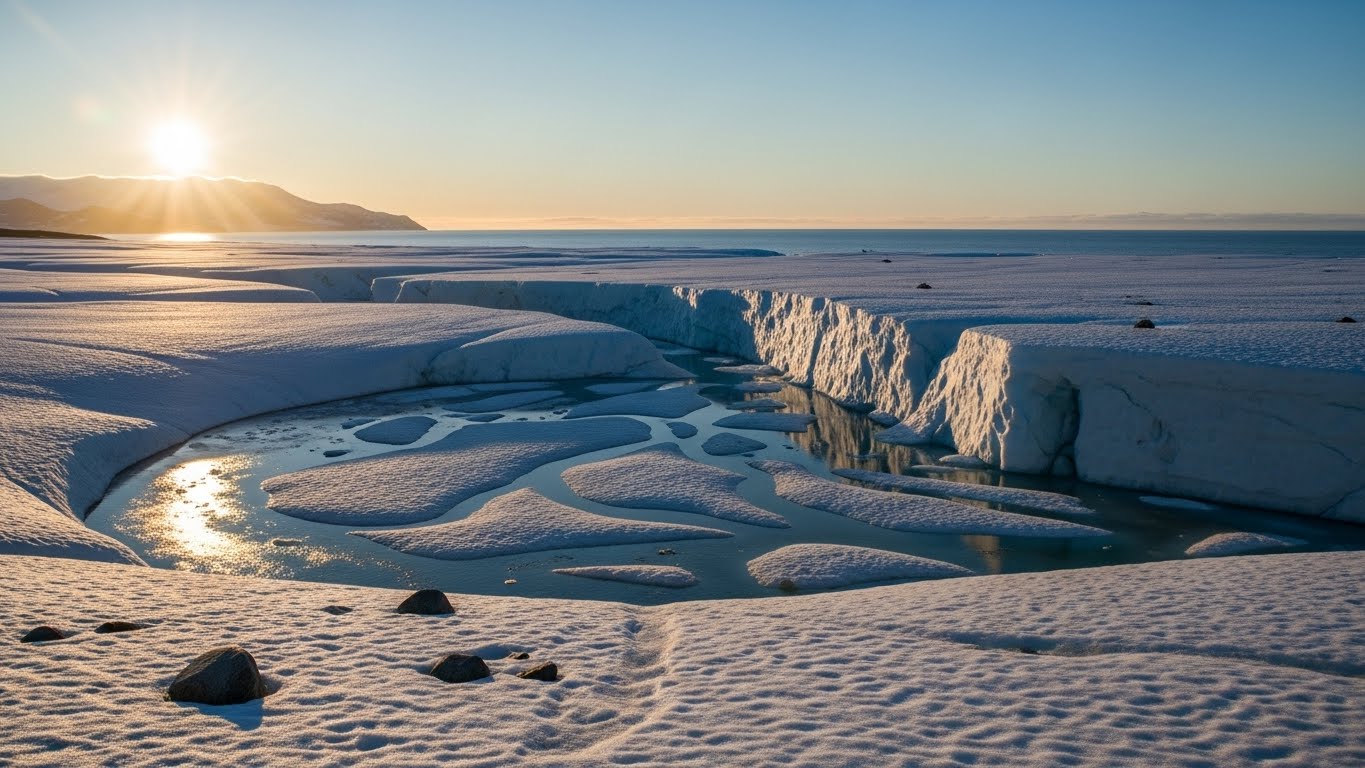
In the Arctic, the changes are not measured in fractions of a degree but in transformations of the landscape itself. A century ago, the ice that covered the Arctic Ocean stretched over a vast area in summer; today, the summer sea ice has shrunk by roughly forty percent since satellite records began in 1979. The old, thick ice that survived for years is largely gone, replaced by young, thin ice that melts more easily. The polar bears that stalk the ice, the walruses that rest on it, and the Indigenous peoples who have hunted on it for millennia are adapting to a world in which the ice — their platform, their hunting ground, and their home — is disappearing beneath them.
The Arctic is the fastest-warming region on Earth, warming roughly four times faster than the global average — a phenomenon known as Arctic amplification. The Arctic is also the canary in the climate coal mine: the changes happening there today are the clearest and most dramatic evidence of the warming that is reshaping the planet. The loss of sea ice is the most visible of these changes, and it has consequences that reach far beyond the poles. This article explores why the Arctic is warming so fast, what the loss of sea ice means, and why the fate of the Arctic matters for the entire planet.
Why the Arctic Warms Faster
The extreme warming of the Arctic is driven by a set of reinforcing feedbacks, and the central one is the albedo effect. Albedo is the reflectivity of a surface: bright, white surfaces like ice and snow reflect most of the sunlight that hits them, sending it back to space, while dark surfaces like open water and exposed land absorb it. When sea ice melts, it exposes dark ocean water, which absorbs far more of the sun's energy, warming the water, which melts more ice — a self-reinforcing loop. The same dynamic operates on land: as snow retreats and ice melts, dark tundra and rock absorb more heat. The loss of the white reflective surface accelerates the warming that causes the loss in the first place.
The Albedo Feedback
The albedo feedback is the engine of Arctic amplification. As the ice retreats each summer, the Arctic Ocean absorbs more heat, delaying the autumn freeze and thinning the ice that forms. The thinner ice is more vulnerable to melting the following spring, so the feedback ratchets the system toward less ice year by year. This is why Arctic sea ice decline has been so consistent and so dramatic: the trend is self-reinforcing. Projections that once assumed ice-free Arctic summers by the end of the century now suggest they could arrive within a decade or two under high emissions. The feedbacks are not speculation; they are measured, and they are compounding.
The Arctic warming is also reinforced by the atmosphere and the ocean. As the ice melts, the exposed ocean releases heat and moisture to the atmosphere, warming the air further. The retreat of snow and ice on the surrounding land exposes dark ground that warms the permafrost, and the warming permafrost releases greenhouse gases that warm the planet further. And the transport of heat into the Arctic — through the atmosphere and the ocean currents that carry warm water northward — is increasing as the global climate warms. The Arctic is at the receiving end of the planet's warming, and its own feedbacks amplify it.
The Changing Ice
The statistics of sea ice loss tell the story. The September minimum — the smallest extent of ice at the end of the summer melt season — has fallen by about forty percent since 1979, from more than seven million square kilometres to closer to four million. The record low was set in September 2012, when the ice shrank to 3.4 million square kilometres, and the years since have regularly approached that record. Just as important as the extent is the character of the ice. The multiyear ice that survives more than one summer — thick, dense, and resilient — has declined dramatically, replaced by first-year ice that is thin, fragile, and prone to melting. The Arctic is not just losing ice; it is losing its oldest, strongest ice, and the ice that remains is far more vulnerable.
The First Ice-Free Summers
The prospect of an ice-free Arctic summer — a September with less than a million square kilometres of ice — has shifted from hypothetical to imminent. Models project that under continued emissions, ice-free summers will arrive within the coming decades, possibly within a decade or two under the highest scenarios. The loss of summer sea ice would be a profound transformation of the Arctic: it would open the Arctic Ocean to shipping, change the region's weather, and remove the habitat on which polar bears, walruses, and seals depend. The first ice-free summer will be a landmark of the climate era — a visible, quantifiable marker of how much the world has changed.
Consequences Beyond the Poles
The loss of Arctic sea ice is not an isolated polar event; it has consequences that ripple across the Northern Hemisphere and the planet.
Weather Connections
The Arctic is intimately connected to the weather of the Northern Hemisphere through the jet stream — the fast-flowing band of wind that circles the pole and steers weather systems. The warming Arctic reduces the temperature difference between the poles and the tropics, and research suggests this weakens and wavies the jet stream, allowing cold air to plunge southward and warm air to surge northward, and causing weather systems to stall. This is the proposed mechanism behind the cold snaps that have struck Europe and North America in recent winters, the persistent blocking highs that drive heatwaves, and the stalled storms that produce flooding. The link between Arctic warming and mid-latitude weather is an active area of research, but the evidence increasingly suggests that the vanishing ice is shaping the weather that hundreds of millions of people experience.
Wildlife and Indigenous Peoples
The Arctic ecosystem is transforming. Polar bears, which depend on sea ice to hunt seals, face declining ice and longer swimming distances; their body condition is declining, and their populations are under pressure. Walruses, which rest on ice between feeding dives, are crowding onto beaches in their tens of thousands, where stampedes can be fatal. Seals, narwhals, and belugas are shifting their ranges, and the plankton and fish at the base of the Arctic food web are changing. For the Indigenous peoples of the Arctic — the Inuit, the Sámi, and others — the ice is not scenery but infrastructure: the platform for hunting, travel, and cultural practice. Its disappearance is an existential threat to their way of life, and they are among the world's first climate refugees within their own lands.
The Permafrost Link
The retreat of sea ice is connected to the thawing of the Arctic's land — the permafrost that underlies much of the region. Permafrost is ground that has remained frozen for at least two consecutive years, and it holds enormous amounts of organic carbon, built up over millennia in the cold. As the Arctic warms, the permafrost thaws, and the organic matter begins to decompose, releasing carbon dioxide and methane to the atmosphere. The permafrost carbon pool is vast — more than twice the carbon currently in the atmosphere — and its release is a potential climate feedback of global significance. The melting of sea ice accelerates the warming that thaws the permafrost, and the permafrost's release of greenhouse gases accelerates the warming that melts the ice — a coupling that makes the Arctic the most important feedback region on Earth.
The Arctic at a Glance
4x: How much faster the Arctic warms than the global average
~40%: Decline in September sea ice extent since 1979
3.4 million: Square kilometres of sea ice at the 2012 record low
Multiyear: The thick, old ice being replaced by thin, fragile first-year ice
2x: The carbon stored in permafrost versus the atmosphere
The Arctic Economy and Geopolitics
The disappearing ice is also redrawing the map of the Arctic economy and geopolitics. The opening of the Arctic Ocean is attracting interest in shipping routes — the Northern Sea Route and the Northwest Passage — that could shorten voyages between Asia, Europe, and North America. The region holds large reserves of oil, gas, and minerals, and the melting ice is making some of them accessible. And the Arctic states — including the United States, Russia, Canada, Norway, and Denmark — are competing for influence and resources in a region where the rules are still being written. The Arctic Council provides a framework for cooperation, but the strain of geopolitics and the accelerating pace of change are testing the region's governance. The melting of the Arctic is not only an environmental story; it is an economic and strategic one.
Conclusion: The Region That Speaks First
The Arctic is the place where climate change has arrived earliest and hardest, and it is telling the world what is coming. The vanishing sea ice is not a distant polar curiosity; it is the most dramatic and best-documented transformation in the climate system, and its consequences — for weather, wildlife, Indigenous peoples, the carbon cycle, and the global economy — reach every corner of the planet. The Arctic is also the place where the feedbacks of the climate system are most visible: the melting that accelerates the warming that accelerates the melting. The response to the Arctic's loss is the response to climate change itself — the emissions cuts that would slow the warming and the adaptation that protects the people and ecosystems on the front line. The Arctic speaks first, and it has been speaking clearly. The question is whether the world is listening, and whether it will act before the ice is gone.
Frequently Asked Questions
Why is the Arctic warming faster than the rest of the world?
Arctic amplification is driven mainly by the albedo feedback: as sea ice melts, it exposes dark ocean water that absorbs more of the sun's energy, warming the water and melting more ice. Atmospheric and oceanic heat transport and the thawing of permafrost reinforce the effect.
How much sea ice has been lost?
September sea ice extent has declined by about forty percent since 1979, from over seven million square kilometres to about four million. The old, thick multiyear ice has been largely replaced by thin, fragile first-year ice, and ice-free summers are projected within decades.
Does Arctic melting affect weather elsewhere?
Yes. The warming Arctic weakens and wavies the jet stream, which can allow cold air to plunge southward, drive persistent heatwaves, and stall weather systems, contributing to extreme winter and summer weather across the Northern Hemisphere.
What is happening to Arctic wildlife?
Polar bears, walruses, seals, and other Arctic species are losing their sea ice habitat. Polar bear body condition is declining, walruses crowd onto beaches, and species are shifting their ranges as the Arctic ecosystem transforms.
Why is permafrost thaw important?
Permafrost stores more than twice the carbon in the atmosphere. As it thaws, that carbon is released as carbon dioxide and methane, accelerating global warming in a feedback loop. The fate of the permafrost is one of the most important unknowns in the climate system.
Related Articles
Arctic Meltdown: Our Final Warning — The broader story of the Arctic's transformation and its implications.
Permafrost Thaw: The Arctic's Dangerous Feedback — The carbon release locked in the thawing frozen ground.
Ocean Currents: The Planet's Climate Conveyor Belt — How the Arctic's freshwater input connects to the global ocean circulation.