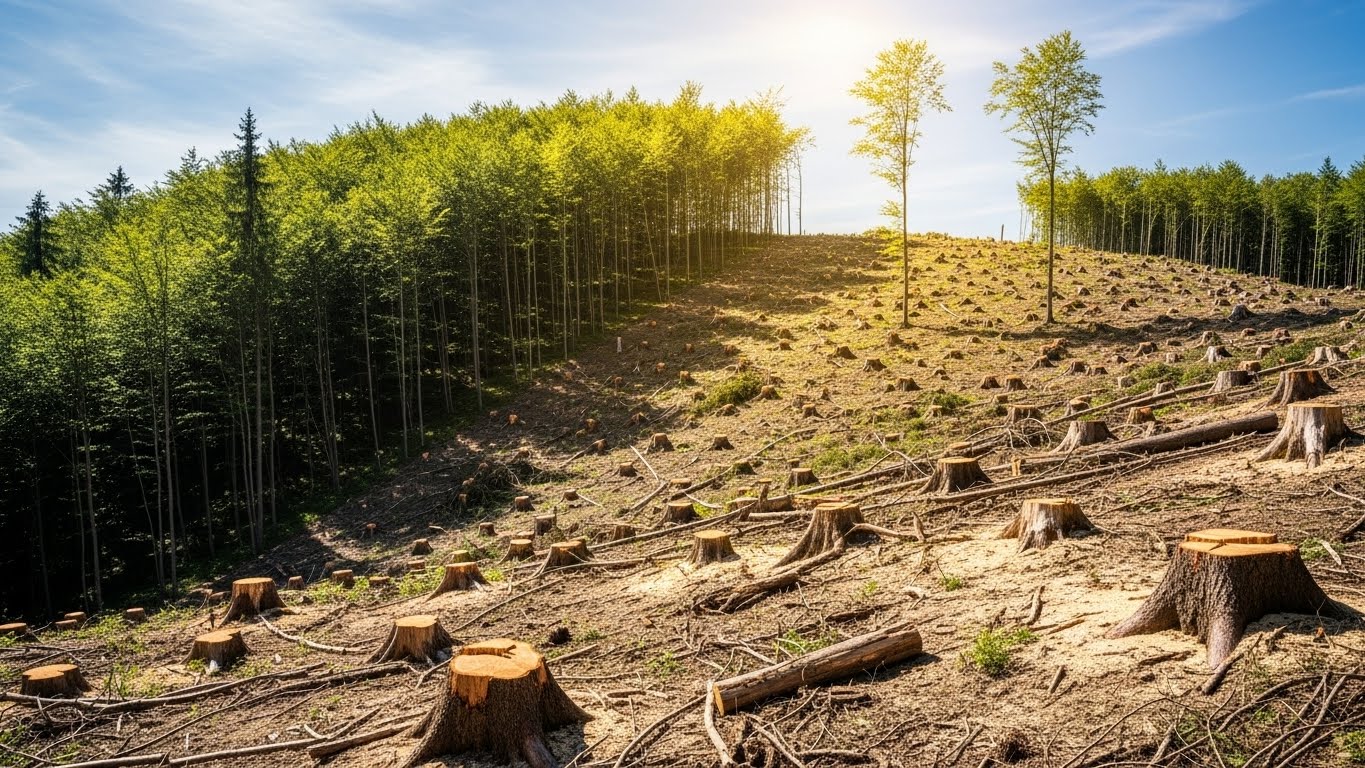
Tropical rainforests are often called the lungs of the planet, and for good reason. They absorb vast quantities of carbon dioxide from the atmosphere, store carbon in their biomass and soils, and regulate rainfall patterns across continents. Yet we are destroying them at an alarming rate. According to the United Nations Environment Programme (UNEP), approximately 10 million hectares of forest are lost each year — an area roughly the size of Iceland. This destruction does more than harm biodiversity and displace indigenous communities; it actively accelerates climate change.
Forests are the second-largest storehouse of carbon on Earth, after the oceans. They hold an estimated 662 gigatonnes of carbon in their biomass, deadwood, litter, and soils. When forests are cleared or burned, that stored carbon is released into the atmosphere as carbon dioxide, the primary driver of global warming. The Intergovernmental Panel on Climate Change (IPCC) estimates that deforestation and forest degradation account for roughly 11 percent of all human-caused greenhouse gas emissions — more than the entire global transportation sector.
The Scale of Global Forest Loss
The world has lost approximately 420 million hectares of forest since 1990 — an area larger than the entire European Union. While the rate of deforestation has slowed in some regions, it remains dangerously high in the tropics. The Food and Agriculture Organization (FAO) reports that between 2015 and 2025, global forest area declined by roughly 47 million hectares, with tropical countries accounting for over 90 percent of the net loss.
Brazil, the Democratic Republic of the Congo, Indonesia, Bolivia, and Peru lead the world in primary forest loss. Primary forests — ancient, undisturbed ecosystems that have developed over centuries — are the most carbon-dense and biodiverse of all forest types. When they are cleared, the ecological damage is largely irreversible on human timescales. Satellite data from NASA and other space agencies has allowed scientists to track these losses in near-real time, revealing a crisis unfolding across every major tropical forest basin.
Deforestation: Key Statistics
- 10 million hectares of forest destroyed every year — the equivalent of 27 football fields per minute
- 11% of global greenhouse gas emissions come from deforestation and forest degradation
- 420 million hectares of forest lost since 1990 — an area larger than the European Union
- 662 gigatonnes of carbon stored in the world’s forests — roughly 60 years of global fossil fuel emissions
- 1.6 billion people depend on forests for their livelihoods, including over 300 million indigenous peoples
- 80% of terrestrial biodiversity lives in forests
How Deforestation Fuels Climate Change
The relationship between deforestation and climate change is a dangerous feedback loop. Forest loss releases carbon dioxide, which warms the climate, which in turn stresses surviving forests, making them more vulnerable to fire, drought, and disease. Understanding the mechanisms by which deforestation drives warming is essential to grasping the urgency of forest protection.
The Carbon Cycle Disrupted
Forests act as carbon sinks — they absorb more carbon dioxide through photosynthesis than they release through respiration and decay. Mature tropical forests can sequester up to 18 tonnes of CO2 per hectare per year. When forests are cleared, two things happen: the carbon sink is eliminated, and the stored carbon is released. If the forest is burned — as happens routinely in the Amazon and Southeast Asia — the release is nearly instantaneous. If it is left to rot, the decomposition process releases the same carbon over a period of years to decades.
The National Oceanic and Atmospheric Administration (NOAA) tracks atmospheric CO2 concentrations at the Mauna Loa Observatory, where levels have risen from 315 parts per million in 1958 to over 425 ppm in 2026. A significant portion of this increase is attributable to land-use change, primarily deforestation. Research published in Nature has shown that tropical forests alone hold more carbon than can be emitted by human activities in the next 30 years at current rates, making their protection an indispensable component of any credible climate strategy.
Albedo, Evapotranspiration, and Regional Climate
Forests influence climate through more than just carbon. They affect the Earth’s albedo, or reflectivity, and they drive evapotranspiration, the process by which water moves from the land to the atmosphere. Dark forest canopies absorb more solar radiation than bare soil or pasture, but this warming effect is more than offset by the cooling provided by evapotranspiration. A single large tree can transpire hundreds of liters of water per day, creating a localized cooling effect equivalent to several air conditioning units running continuously.
When forests are removed, evapotranspiration stops. The land becomes hotter and drier. A 2023 study in Science found that deforestation in the Amazon could reduce rainfall across the basin by 15 to 30 percent during the dry season, threatening the forest’s ability to regenerate and potentially triggering a tipping point into a savanna-like state. The World Meteorological Organization (WMO) has identified Amazon dieback as one of the most consequential climate tipping points, with the power to accelerate global warming substantially.
Tropical Forests Under Siege
While deforestation occurs on every continent except Antarctica, the crisis is most acute in the tropics, where more than 95 percent of deforestation-related carbon emissions occur. Three major forest basins — the Amazon, the Congo Basin, and Southeast Asia — are at the epicenter of the crisis.
The Amazon Rainforest
The Amazon is the largest tropical rainforest on Earth, spanning nine countries and storing an estimated 120 gigatonnes of carbon. It has been called the “air conditioner of the planet” for its role in regulating global and regional climate. But the Amazon is under relentless pressure. Cattle ranching accounts for approximately 80 percent of deforestation in the Brazilian Amazon, followed by soy cultivation and illegal logging. The World Bank estimates that the economic value of the Amazon’s ecosystem services — carbon storage, rainfall generation, biodiversity — is in the trillions of dollars, far exceeding the short-term profits from clearing it for agriculture.
In 2024 and 2025, the Brazilian Amazon experienced some of the worst fire seasons in two decades, driven by a combination of deforestation and severe drought linked to climate change. Satellite data from NASA’s Earth Observing System showed smoke plumes stretching thousands of kilometers, darkening skies as far away as São Paulo. Scientists at the IPCC warn that continued deforestation could push the Amazon past a tipping point where it can no longer sustain its own rainfall, transforming large portions of the rainforest into dry savanna and releasing tens of billions of tonnes of carbon in the process.
The Congo Basin and Southeast Asia
The Congo Basin is the world’s second-largest tropical rainforest and one of the most carbon-rich ecosystems on the planet. It has historically experienced lower deforestation rates than the Amazon, but pressure is growing. Industrial logging, charcoal production, and small-scale agriculture are expanding rapidly, driven by population growth and weak governance. The basin is also increasingly threatened by climate change itself: rising temperatures and shifting rainfall patterns are making large areas more susceptible to fire.
In Southeast Asia, the primary driver of deforestation is the expansion of oil palm plantations. Indonesia and Malaysia together account for more than 80 percent of global palm oil production, and the industry has been responsible for the destruction of vast swaths of peatland forests, which are among the most carbon-dense ecosystems on Earth. Draining and burning peatlands for oil palm cultivation releases enormous quantities of CO2 — up to 100 tonnes per hectare per year, according to research from Nature Communications. The resulting haze from peat fires regularly causes public health emergencies across the region.
“We have a brief and rapidly closing window to secure a liveable and sustainable future for all. Halting deforestation and restoring degraded forests is one of the most effective and cost-efficient climate solutions available — and it must happen now.” — IPCC Synthesis Report, 2023
The Drivers of Deforestation
Understanding what drives deforestation is essential to designing effective solutions. The forces behind forest loss vary by region, but several common themes emerge: agricultural expansion, commodity demand, weak governance, and inadequate land rights.
Agriculture and Commodity Production
Agricultural expansion accounts for approximately 80 percent of tropical deforestation worldwide. The four most destructive commodities are beef, soy, palm oil, and wood products. Together they drive the majority of forest loss in the Amazon, the Cerrado, the Congo Basin, and Southeast Asia. Global demand for these products — much of it from wealthy nations — creates powerful economic incentives to clear forests. The World Bank has highlighted that reforming agricultural supply chains and implementing zero-deforestation commitments by major corporations could significantly reduce forest loss, but voluntary pledges have so far fallen short of their targets.
Illegal Logging and Mining
Illegal logging is estimated to account for 15 to 30 percent of the global timber trade. It undermines forest governance, deprives governments of revenue, and drives degradation even in officially protected areas. Illegal gold mining has become a major driver of deforestation in the Amazon, where miners clear forest, dredge rivers, and release mercury into waterways. The UN Environment Programme (UNEP) estimates that illegal mining now affects over 2,000 square kilometers of the Peruvian Amazon alone, with devastating consequences for indigenous communities and aquatic ecosystems.
Solutions: Protecting and Restoring Forests
Despite the bleak picture, there are proven solutions. Forest protection, when combined with strong governance, indigenous land rights, and sustainable economic alternatives, can dramatically reduce deforestation. Restoration of degraded lands can sequester carbon and restore ecosystem function. The global community has the tools and the knowledge to end deforestation — what is lacking is the political will and financial commitment to do so at scale.
Indigenous Land Rights and Protected Areas
One of the most effective forest conservation strategies is also one of the simplest: recognize and enforce indigenous land rights. A growing body of research, including studies published in Nature Sustainability, shows that deforestation rates on indigenous territories are two to three times lower than on adjacent lands. Indigenous communities have managed their forests sustainably for centuries, and their traditional knowledge is increasingly recognized as essential to climate mitigation. The UNEP reports that territories managed by indigenous peoples and local communities cover at least 32 percent of the world’s forests and store more than 20 percent of the carbon held in tropical forests.
Reforestation and Natural Regeneration
Restoring degraded and deforested lands has the potential to sequester billions of tonnes of carbon. The IPCC estimates that reforestation and afforestation could provide up to 18 percent of the mitigation needed to limit warming to 1.5°C by 2050. However, experts caution that tree planting cannot replace the protection of existing forests. Mature primary forests store far more carbon than young plantations, and many large-scale tree-planting initiatives have failed because they planted monocultures of non-native species that provide little benefit for biodiversity or long-term carbon storage. The most effective restoration strategies prioritize natural regeneration and the planting of diverse native species suited to local conditions.
Policy, Finance, and Global Commitments
On the policy front, the Glasgow Leaders’ Declaration on Forests and Land Use, signed at COP26 by over 140 countries, committed to ending deforestation by 2030. Progress since then has been mixed. The World Bank’s Forest Carbon Partnership Facility and the REDD+ framework have channeled billions of dollars to forest-rich countries to support conservation, but funding remains a fraction of what is needed. A 2025 analysis by the UN Environment Programme found that total international public finance for forest protection amounts to less than $2 billion per year, while the economic value destroyed by deforestation exceeds $200 billion annually. Bridging that gap — by redirecting agricultural subsidies, imposing tariffs on commodities linked to deforestation, and scaling up results-based payments — is one of the highest-leverage climate actions available.
Frequently Asked Questions
How much does deforestation contribute to climate change?
Deforestation accounts for approximately 11 percent of global greenhouse gas emissions, primarily from tropical countries. This makes it the second-largest source of human-caused emissions after fossil fuel combustion. The IPCC identifies reducing deforestation as one of the most cost-effective climate mitigation strategies available.
Which country is losing forest the fastest?
Brazil currently has the highest rate of tropical primary forest loss, driven primarily by cattle ranching and soy production in the Amazon. In 2024 alone, the country lost over 2 million hectares of primary forest. The Democratic Republic of the Congo, Indonesia, Bolivia, and Peru also rank among the top deforesting nations.
Can planting trees solve climate change?
Tree planting is a valuable tool, but it cannot replace existing forests. Mature primary forests store vastly more carbon than newly planted saplings, and it takes decades — often centuries — for restored forests to approach the carbon density of old-growth ecosystems. Protecting standing forests is far more effective than planting new ones over the critical next 10 to 30 years.
How do indigenous peoples help protect forests?
Indigenous territories maintain deforestation rates two to three times lower than adjacent areas, even when they face intense pressure from logging and agriculture. Studies published in Nature and other journals have demonstrated that recognizing indigenous land rights is one of the most effective and equitable forest conservation strategies available.
What products drive deforestation the most?
Beef, soy, palm oil, and wood products are the four largest drivers of tropical deforestation, together accounting for over 70 percent of forest loss. Consumers in wealthy nations can help by choosing certified sustainable products, reducing food waste (especially meat), and supporting policies that require deforestation-free supply chains.
Related Articles
The Carbon Lockout Window — Understanding the narrow window to lock in clean energy infrastructure before it is too late.
Arctic Meltdown: Our Final Warning — The Arctic is warming four times faster than the global average — a final warning for humanity.
Climate Change 101: The Science You Need to Know — Understand the greenhouse effect, feedback loops, and climate tipping points in plain language.