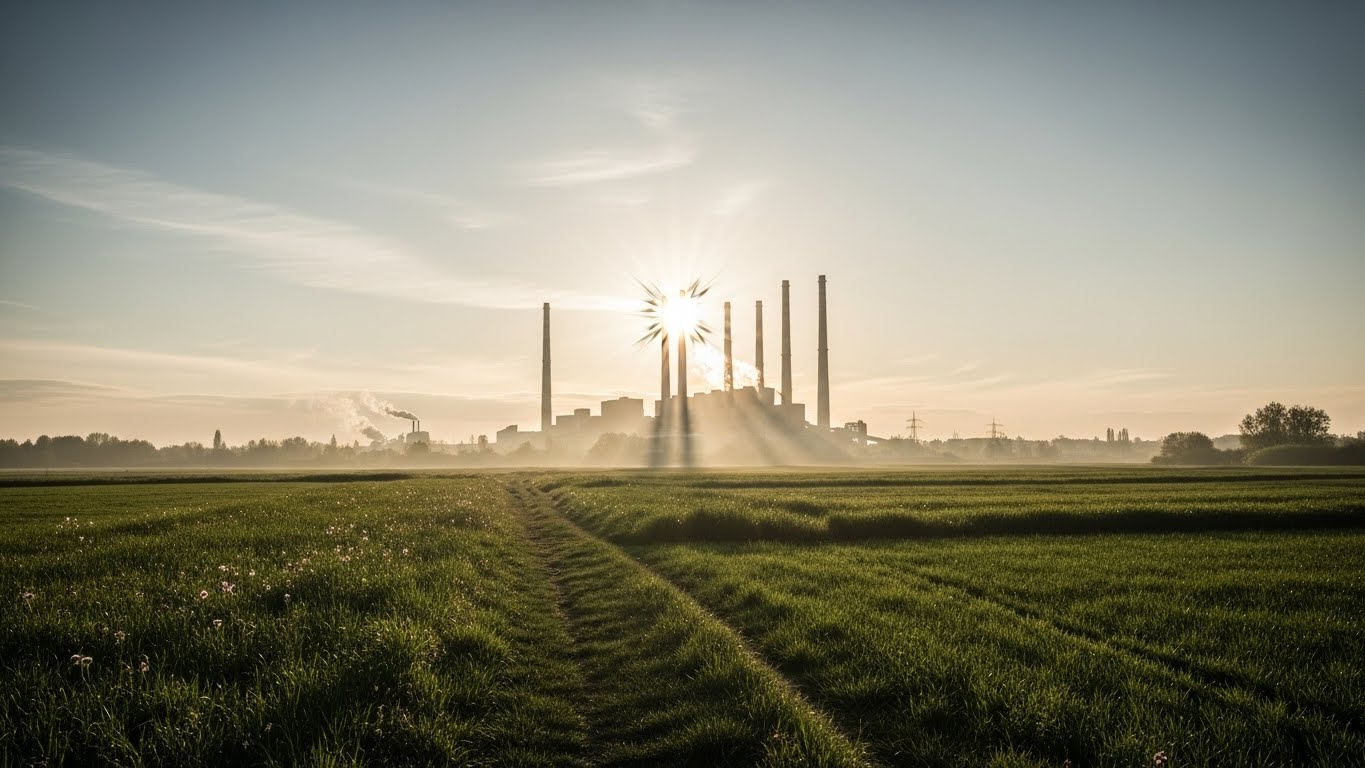
There is a contradiction at the heart of the climate challenge: the world must reach net zero, but some emissions are extremely difficult to eliminate. A cement plant releases carbon dioxide not only from burning fuel but from the chemical transformation of limestone itself — the process emissions are unavoidable, no matter what fuel is used. A steel mill, a chemical factory, and a gas-fired power plant that must run for grid stability all face the same problem. And then there is the legacy problem: the carbon dioxide that has already been emitted, billions of tonnes of it, which the planet must eventually remove if the concentration of greenhouse gases is to be brought back down. For all of these, the answer that technology offers is carbon capture: trapping carbon dioxide at its source, or pulling it from the air, and storing it permanently out of the atmosphere.
Carbon capture and storage (CCS) is a family of technologies with two distinct roles. The first is capture at the point of emission — scrubbing carbon dioxide from the exhaust of industrial plants and power stations and storing it underground. The second is direct air capture (DAC) — pulling carbon dioxide directly from the ambient atmosphere, regardless of where it was emitted, and storing it. Both are controversial, expensive, and often misunderstood, but they are increasingly central to the world's climate plans. This article explains how carbon capture works, what it can and cannot do, and why it is both indispensable and insufficient.
How Carbon Capture Works
Carbon capture begins with separation. The exhaust of an industrial plant is mostly nitrogen and other gases, with carbon dioxide present as a relatively small share. Capturing it means separating the carbon dioxide from the rest of the stream. The most common method is amine scrubbing, in which the exhaust is bubbled through a chemical solvent that absorbs carbon dioxide; the solvent is then heated to release the pure carbon dioxide, which is compressed for transport. Newer methods use membranes, solid sorbents, or oxy-fuel combustion, in which the fuel is burned in pure oxygen so that the exhaust is almost entirely carbon dioxide. The captured carbon dioxide is then compressed into a dense fluid, transported — typically by pipeline — and injected into deep geological formations: depleted oil and gas reservoirs, saline aquifers, or the basalt formations that can mineralize the carbon permanently.
Direct Air Capture
Direct air capture works on a different principle. Instead of scrubbing the concentrated exhaust of a factory, it draws huge volumes of ambient air — which contains carbon dioxide at only about 0.04 percent — through chemical sorbents that trap the carbon. The energy and cost are therefore much higher than point-source capture, because the carbon is far more diluted. But DAC has a unique advantage: it can remove carbon that has already been emitted, from anywhere in the world, and it does not depend on a plant having a capture system installed. DAC plants, which use heat and chemical cycles to release the captured carbon for storage, have been built at pilot and early commercial scale, and the costs are expected to fall with deployment — though they remain high.
What Carbon Capture Can Do
The honest assessment of carbon capture is that it has a necessary but limited role. Its necessary role is in the sectors that cannot otherwise reach zero emissions.
The Hard-to-Abate Sectors
Cement, steel, chemicals, and fertilizer production generate process emissions that no amount of clean energy can eliminate. For these industries, carbon capture is effectively the only route to net zero. The same applies to parts of the gas power fleet, and to some industrial heat applications. The International Energy Agency's net-zero scenario relies on carbon capture to handle the residual emissions of these sectors, and the IPCC's assessments likewise include CCS in the pathways that limit warming to 1.5°C. For these industries, carbon capture is not a luxury; it is a necessity.
The Removals Role
Beyond point-source capture, the removals role is growing in importance. Even in the most aggressive decarbonization scenarios, some emissions are projected to remain in 2050 — from agriculture, aviation, and industrial processes — and these must be balanced by removals to reach net zero. And if the world is to go beyond net zero, to actively reduce the atmospheric concentration of greenhouse gases, removals — including direct air capture and the natural removals of forests and soils — become the central technology. The IPCC has been clear that the world will need billions of tonnes of removals per year by mid-century, and carbon capture, especially DAC, is one of the few technologies that can deliver them at scale.
The Limits and Controversies
The case against carbon capture is also substantial, and it cannot be dismissed. The most serious criticism is that CCS has been used as an excuse to prolong the fossil fuel era. The oil and gas industry has promoted carbon capture, and much of the CO2 captured to date has been injected into oil reservoirs to extract more oil — a technique called enhanced oil recovery that produces additional emissions even as it stores some carbon. Critics argue that CCS is a smokescreen that allows continued fossil fuel extraction, and the record of large CCS projects is mixed: several high-profile projects have failed to deliver on their promises, and the technology has consistently underperformed expectations and overrun costs.
Cost, Scale, and Energy
The practical limits are equally real. Carbon capture consumes a significant share of a plant's energy — capturing CO2 is itself an energy-intensive process that adds cost and reduces efficiency. The cost of capture, transport, and storage is high, and the scale required — billions of tonnes per year of storage — demands an enormous build-out of pipelines and injection sites that is only beginning. Direct air capture is even more expensive, and its energy and land requirements are substantial. The arithmetic of CCS is unforgiving: it is almost always cheaper to avoid an emission than to capture it, and cheaper to capture at the source than from the air. This is why carbon capture can complement but never substitute for the deep emissions cuts that remain the core of climate action.
Carbon Capture at a Glance
~45 million: Tonnes of CO2 captured per year by global CCS facilities — a fraction of the billions needed
0.04%: The concentration of CO2 in ambient air that direct air capture must work with
Billions: of tonnes per year of removals the world will need by mid-century
Process: The unavoidable cement and steel emissions that only CCS can eliminate
Enhanced oil recovery: The controversial use of captured CO2 to extract more oil
The Policy and the Future
Carbon capture is being scaled up through policy and investment. Governments have introduced tax credits — most prominently the United States' 45Q credit, which pays for each tonne of carbon captured and stored — and announced large-scale hub projects to build shared CO2 transport and storage infrastructure. The European Union has included CCS in its industrial decarbonization plans, and private investment is flowing into both point-source capture and direct air capture startups. The trajectory resembles the early days of renewable energy: expensive, contested, and dismissed by many — but with costs falling and deployment growing. The question is whether the technology can achieve the scale and cost reductions that its advocates project, and whether its use is disciplined — reserved for the sectors that need it, rather than used to prolong the fossil fuel economy.
Conclusion: Necessary but Not Sufficient
Carbon capture is neither the savior its advocates sometimes claim nor the scam its critics sometimes allege. It is a necessary technology for the hard-to-abate sectors of industry, and an essential tool for the removals that net zero and beyond will require. It cannot replace the transformation of the energy system — it is almost always cheaper and more effective to avoid an emission than to capture it — and it must not be used as an excuse to keep burning fossil fuels. The honest role of carbon capture is that of an essential complement: it handles the emissions that cannot be avoided, and it removes the carbon that has already been released. The world needs it, but it needs it in its proper place — alongside, and never instead of, the deep cuts in emissions that are the heart of climate action.
Frequently Asked Questions
What is carbon capture and storage (CCS)?
CCS is a family of technologies that capture carbon dioxide from industrial exhaust or directly from the air, compress and transport it, and inject it into deep geological formations for permanent storage.
Why is carbon capture needed?
Some sectors, like cement, steel, and chemicals, have process emissions that cannot be eliminated by clean energy alone. Carbon capture is the only route to net zero for these industries, and removals like direct air capture are needed to offset residual emissions.
What is direct air capture?
Direct air capture (DAC) pulls carbon dioxide directly from the ambient atmosphere using chemical sorbents, then stores it. It can remove carbon that has already been emitted, but it is more expensive than point-source capture because the carbon is far more diluted in air.
Why is carbon capture controversial?
It is controversial because the oil and gas industry has used it to prolong fossil fuel extraction, some of it is used for enhanced oil recovery, and many projects have underperformed or overrun costs. It is also expensive and consumes energy, so it cannot substitute for emissions cuts.
Can carbon capture solve climate change alone?
No. It is almost always cheaper to avoid an emission than to capture it, so carbon capture must complement — never replace — deep cuts in emissions. Its proper role is handling unavoidable industrial emissions and providing the removals that net zero requires.
Related Articles
Net Zero Explained: What It Means and How to Get There — The role of removals in balancing the emissions that cannot be eliminated.
Carbon Pricing and Carbon Markets: Making Polluters Pay — The markets in which captured and removed carbon is traded.
Green Hydrogen: Fueling the Hardest-to-Decarbonize Sectors — The other pillar of the hard-to-abate transition.