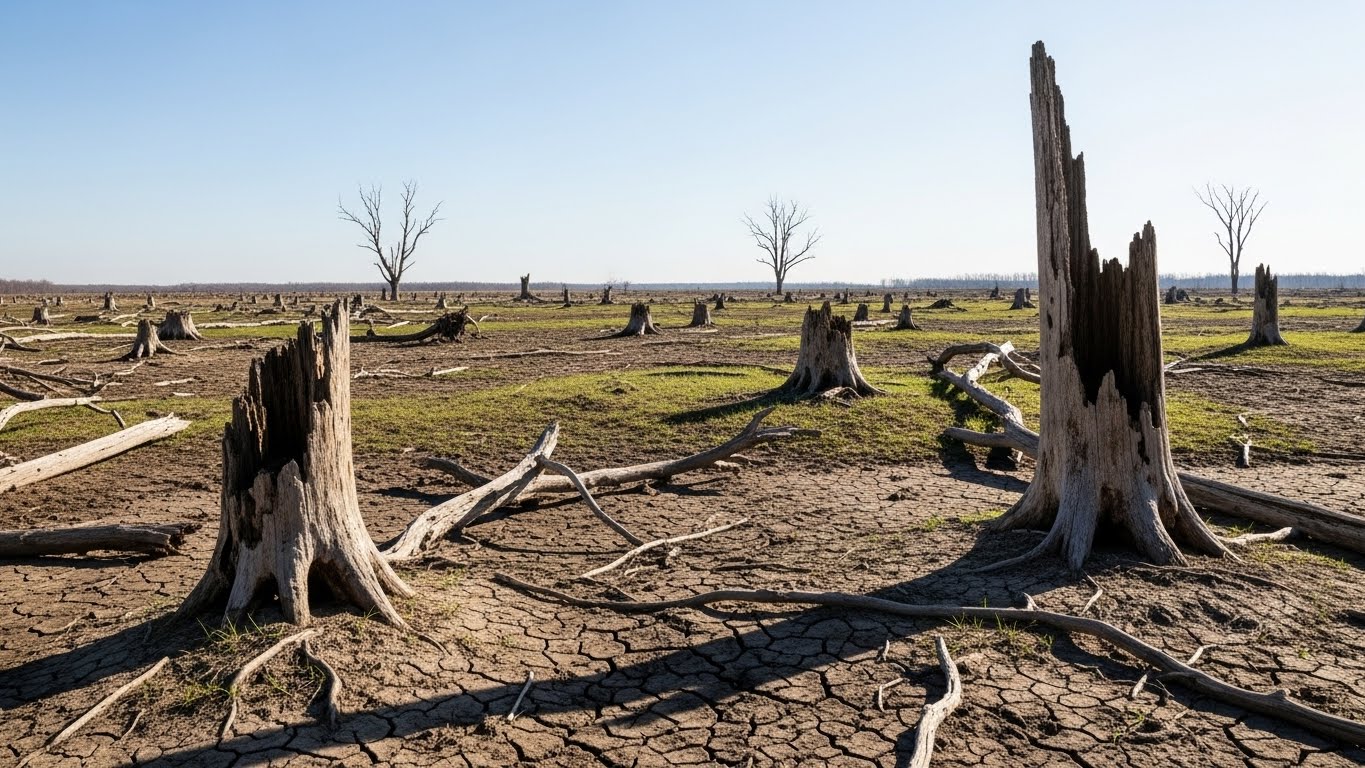
Every species on Earth is part of a web of life, and every strand of that web is connected to the climate. The coral that feeds the fish, the fish that feed the fisherman; the tree that shades the stream, the stream that waters the field; the insect that pollinates the crop, the crop that feeds the family — all of it runs on the energy of the sun and the water and air that the climate regulates. When the climate changes, every strand of the web feels the pull. And when species disappear, the web weakens in ways that feed back on the climate itself. The biodiversity crisis and the climate crisis are not two separate problems that happen to coincide; they are two symptoms of the same rupture between humanity and the natural world.
The numbers are sobering. The Intergovernmental Science-Policy Platform on Biodiversity and Ecosystem Services has estimated that up to one million species are at risk of extinction, many within decades. The rate of species loss is tens to hundreds of times the natural background rate. And climate change is accelerating the loss: warming shifts the ranges of species, disrupts the timing of seasonal events, bleaches the coral that shelters a quarter of marine life, and pushes species up mountainsides and toward the poles until there is nowhere left to go. Meanwhile, the loss of biodiversity weakens the very ecosystems — forests, wetlands, oceans — that absorb carbon and buffer the climate. Protecting biodiversity and stabilizing the climate are, in the end, the same project.
How Climate Change Drives Extinction
Climate change drives species loss through several mechanisms, and they interact. The most direct is range shift: as temperatures rise, species must move to stay within their climatic niche, and they are doing so — up mountainsides, toward the poles, and to greater depths. But species cannot always keep pace. Trees cannot walk; animals hit barriers of cities, farmland, and oceans; and species adapted to mountaintops or polar ice have nowhere left to go. The species most at risk are those with small ranges, slow dispersal, and specific habitat requirements — the coral species of a single reef, the frogs of a single mountain cloud forest, the plants of a single valley.
Timing Mismatches
A second mechanism is the disruption of timing. In a warming world, spring arrives earlier, and species respond at different rates. The caterpillar emerges when its food plant blooms; the bird migrates to feed on the caterpillar. If the plant and the bird respond at different speeds, the links of the food web break — a phenomenon called phenological mismatch. Studies have documented such mismatches across terrestrial and marine systems, from the woodland birds of Europe to the krill and cod of the warming seas. These broken links ripple through the ecosystem, reducing the success of species that depend on the timing of others.
Extreme Events and Synergies
Climate extremes — heatwaves, droughts, floods, and fires — now strike more often and harder, and they can kill species faster than gradual warming. The bushfires of Australia in 2019–20, intensified by heat and drought, are estimated to have killed or displaced billions of animals and pushed some species toward extinction. Marine heatwaves have caused mass mortality of corals, seagrasses, and kelp forests, wiping out habitat in weeks. And the extreme events interact with the other drivers of biodiversity loss — habitat destruction, pollution, overexploitation, and invasive species — in ways that compound the damage. A species already weakened by habitat loss is far more vulnerable to a climate shock.
Why Biodiversity Matters for the Climate
The relationship between biodiversity and climate is reciprocal. Just as climate change drives biodiversity loss, biodiversity loss feeds back on the climate — and the feedback can be dangerous. Ecosystems are the Earth's carbon capture and storage system, and their capacity to absorb carbon depends on their health. A diverse, intact forest stores more carbon than a degraded one; a mangrove system teeming with life buries carbon faster than a dying one; a healthy ocean with thriving plankton pumps carbon into the deep. When species are lost and ecosystems degrade, they release carbon and lose their capacity to absorb it. The Amazon, the world's largest rainforest, has in recent years flipped in parts from a carbon sink to a carbon source, as deforestation and fire have overwhelmed its capacity to absorb. The loss of biodiversity is not only an ethical tragedy; it is a climate accelerant.
The Keystone Effect
Some species matter out of all proportion to their numbers. Keystone species — the beaver that builds ponds, the elephant that clears savanna, the coral that builds the reef, the apex predator that controls prey — shape their entire ecosystems. When they are lost, the ecosystem can collapse in ways that release carbon and destabilize the climate. The loss of a keystone species is like removing a load-bearing wall: the structure does not simply lose that element, it can fall. Protecting biodiversity is therefore not an optional amenity of climate action; it is a precondition of the climate system's continued function.
Protecting Biodiversity and Climate Together
The recognition that the two crises are one has reshaped the international agenda. The Kunming-Montreal Global Biodiversity Framework, agreed in 2022, set a target to protect thirty percent of the world's land and ocean by 2030 — the "30x30" target. The framework explicitly links biodiversity protection to climate action, recognizing that protected areas are simultaneously climate mitigation, climate adaptation, and conservation. The expansion of protected areas is one of the most effective and popular measures available: it safeguards the ecosystems that store carbon, gives species room to move as the climate shifts, and provides a refuge for the web of life. Indigenous peoples, who manage much of the world's remaining biodiversity on their lands, are the frontline custodians of this protection, and the evidence shows that territories governed by Indigenous communities often have the lowest deforestation and highest biodiversity of all.
Restoration at Scale
Beyond protection, restoration is the second pillar. The UN Decade on Ecosystem Restoration, running to 2030, has put restoration at the center of the global response. Restoring degraded forests, wetlands, grasslands, and coastal ecosystems rebuilds habitat, sequesters carbon, and restores the services that ecosystems provide. The Bonn Challenge has committed countries to restoring hundreds of millions of hectares of degraded land. Restoration is not without its risks — badly designed tree-planting, including vast monocultures of non-native species, can harm biodiversity and store less carbon than the natural ecosystems they replace — but well-designed restoration that prioritizes native species and ecosystem function delivers for both nature and climate.
Biodiversity and Climate at a Glance
1 million: Species estimated to be at risk of extinction
30%: The target share of land and ocean to be protected by 2030 (30x30)
~10x: How much faster the current species loss rate is than the natural background rate
~70%: Share of tropical forests' carbon-absorbing capacity at risk under continued deforestation
~80%: Share of remaining biodiversity in territories managed by Indigenous peoples
The Business of Nature
The economics of nature are finally being counted, and the accounting is striking. The World Economic Forum has estimated that more than half of the world's GDP — over $44 trillion — depends on nature and its services. Biodiversity is the natural capital behind the industries of food, fibre, medicine, tourism, and water. Businesses are beginning to recognize their dependence on nature, and financial institutions are beginning to price the risk of its loss. The Taskforce on Nature-related Financial Disclosures, modeled on the climate disclosure movement, is pushing companies to report on their impacts on and dependence on nature. The message is spreading: nature is not a free input to be consumed and discarded; it is the foundation of the economy, and its loss is a risk to the financial system itself.
Conclusion: One Planet, One Crisis, One Response
The biodiversity and climate crises are two faces of the same problem: humanity has overrun the natural systems that sustain it. The response must therefore be one response. Protecting and restoring the web of life is simultaneously climate mitigation, climate adaptation, and the foundation of human well-being. The good news is that the tools exist — protected areas, restoration, sustainable management, and the leadership of Indigenous and local communities — and the political framework has finally recognized the connection. The bad news is the pace: species are being lost and ecosystems degraded faster than the response is moving. The choice is clear. Humanity can continue to unravel the web that holds the world together, or it can repair it. The climate, the species, and the billions of people who depend on the web of life are watching.
Frequently Asked Questions
How does climate change cause biodiversity loss?
Climate change drives species loss by shifting ranges, disrupting seasonal timing, increasing extreme events like heatwaves and fires, and combining with habitat loss and pollution. Species that cannot move or adapt fast enough face extinction.
Why does biodiversity loss worsen climate change?
Ecosystems absorb and store carbon. When species are lost and ecosystems degrade, they release stored carbon and lose their capacity to absorb more, accelerating climate change. Healthy, diverse ecosystems are the Earth's carbon capture and storage system.
What is the 30x30 target?
The 30x30 target, set by the Kunming-Montreal Global Biodiversity Framework, aims to protect thirty percent of the world's land and ocean by 2030. It links biodiversity conservation directly to climate mitigation and adaptation.
What can be done to protect biodiversity and climate together?
Expand protected areas, restore degraded ecosystems with native species, manage lands and seas sustainably, support Indigenous and community-led stewardship, and integrate nature into economic and financial decision-making.
Why are Indigenous peoples important for conservation?
Indigenous peoples manage territories that hold much of the world's remaining biodiversity, and research shows their lands often have the lowest deforestation and highest biodiversity. Supporting Indigenous stewardship is one of the most effective ways to protect nature and carbon.
Related Articles
Biodiversity Loss and the Climate Crisis — The scale of species decline and its connection to a warming world.
Nature-Based Solutions: Letting Ecosystems Fight Climate Change — How protecting and restoring nature helps stabilize the climate.
Forest Protection: The World's Greatest Natural Carbon Sink — Protecting the forests that store carbon and shelter life.